personality
picks
Curiosity looks good on you.

A little self-discovery. A few surprises.

The Top 10
Personality Tests
on the Internet.

Know yourself. Or at least have something interesting to argue about over lunch.

Ten websites, plenty of personality. Here’s what you can do on each one, what it costs, and what’s worth sticking around for.

Find your next rabbit hole
16Personalities illustrated test introduction
Four letters. Lots to talk about.
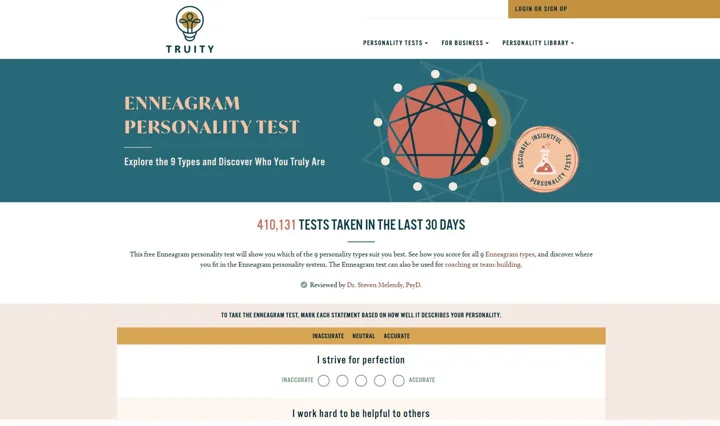
Truity Enneagram personality test
What makes you tick?
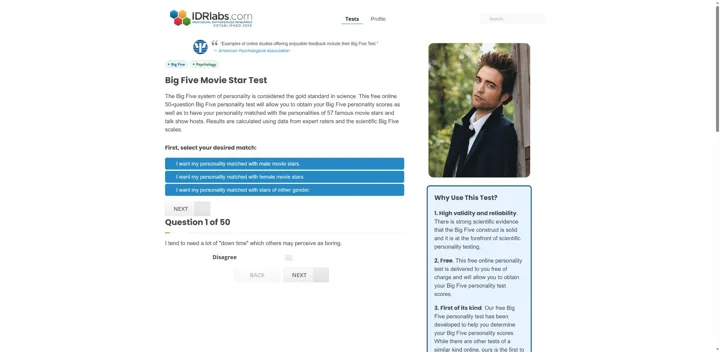
IDRlabs Movie Star personality test
A little Hollywood in the mix.
No perfect score.
Just interesting you.

Start anywhere. Some of these sites dig into traits. Some give you a type, an animal or a famous face. Pick the question that makes you curious.

Updated October 29, 2026
The approach & the small print

Ten picks for different moods and interests. The numbers help you find your place; they aren’t scientific scores.

01

16Personalities

For the friend who already knows their four letters.
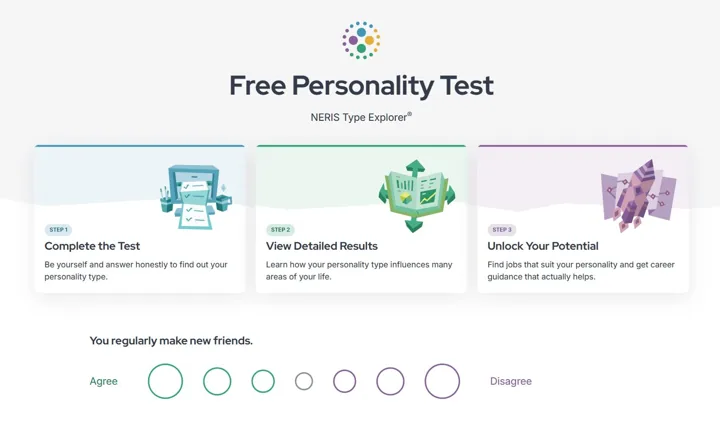
Screenshot of 16Personalities website
NERIS Analytics Limited · Actual site screenshot
What does it cost?Free results; paid extras
Explore 16Personalities

Someone in your group chat probably has an INFP, ENTJ or similar collection of letters ready to explain their entire weekend. This is a good place to find out what the conversation is about. 16Personalities turns its results into illustrated characters with names such as Architect, Mediator and Adventurer, then gives you plenty to read about them.

The attraction is the follow-through. You can wander through descriptions of relationships, friendships and working life, comparing what sounds familiar with what makes you raise an eyebrow. It gives you vocabulary for talking about yourself, which can be more interesting than simply collecting a label.

One useful distinction: those familiar letters do not make this the official Myers-Briggs test. This is NERIS’s own five-scale framework, including its Assertive/Turbulent dimension. Start with the free assessment and profiles; career and team products are optional paid territory.

Try this: Read a neighboring type, too. The bits that don’t fit can be just as interesting as the bits that do.

Pros

  • Illustrated characters make the results easy to get into
  • Plenty of free personality reading after the quiz
  • A clear explanation of its own framework

Cons

  • A tidy type description can feel neater than real life
  • Career and team extras can cost money
Sources & the small print

Price details: Free assessment and type descriptions; optional premium career and team products. Premium prices not verified.

Access: The framework page explicitly says registration and a trial are unnecessary for the assessment.

Evidence: NERIS publishes internal-consistency, retest and validity analyses. These concern its own scales; Big Five research does not automatically validate its type categories.

Background: NERIS uses a Myers-Briggs-style letter format and reworked Big Five dimensions. It is a separate instrument from the official MBTI.

What we checked: Official public pages and interface reviewed; full questionnaire, result and checkout flows not all tested. Checked October 29, 2026.

02

BigFive-test.com

For people who would rather have a personality map than a label.

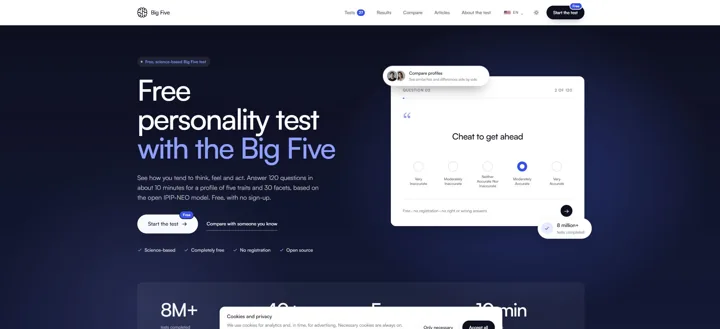
Screenshot of BigFive-test.com website
BigFive-test.com · Actual site screenshot
What does it cost?Free test and detailed results
Explore BigFive-test.com

Are you outgoing with friends but quiet in a room full of strangers? Congratulations: you may be more complicated than a single label. BigFive-test.com gives you a set of trait scores to explore, with five broad dimensions and 30 smaller facets underneath them.

There are 120 statements, so this is a sit-down-with-a-cup-of-something quiz rather than a quick distraction in the supermarket queue. The payoff is detail. You can look at the smaller pieces of a trait instead of treating your whole personality as one big yes-or-no answer.

There is a social side, too. Its comparison tools let you put profiles alongside a partner, friend or colleague and see where you line up. That is a useful invitation to ask questions: what does “being sociable” look like to each of you? The test and detailed results are free, and the provider says no registration is needed.

Try this: Compare with someone you know well. Start with the biggest surprise, rather than asking who got the “better” score.

Pros

  • Free detailed results, with no sign-up
  • Thirty facets give you more to explore
  • Profile comparisons make a good conversation starter

Cons

  • 120 statements is a commitment
  • Comparison scores deserve context, not a winner’s podium
Sources & the small print

Price details: Provider says the test and detailed results are completely free.

Access: Official pages explicitly say no sign-up or registration.

Evidence: The site identifies its source inventory and scoring. Evidence for the Big Five and IPIP-NEO-120 does not independently verify this site's code or every translation.

Background: Uses John A. Johnson's IPIP-NEO-120, documented in a 2014 research paper, with public-domain IPIP items.

What we checked: Official public pages and interface reviewed; full questionnaire, result and checkout flows not all tested. Checked October 29, 2026.
03

Animal In You

A web personality-test original with a 15-book family.

Screenshot of Animal In You website
Animal In You · Actual site screenshot
What does it cost?Free test and results
Explore Animal In You

Not the most buttoned-up personality test on this list. Quite possibly the most fun to play with. You know the friend who commands a room like a lion, the night owl who is only getting started at midnight, or the cautious deer who notices everything? Animal In You takes that familiar habit of seeing animals in people and builds a whole playground around it.

A book-born original of the web personality-quiz world, it has a family of 15 books behind it. The online quiz takes just ten questions to point you toward one of approximately 50 animal profiles. The idea underneath the menagerie is that human communities, like animal communities, make room for different survival strategies: bold leaders, watchful observers, sociable group members and independent wanderers. That is the site’s working theory, not a proven scientific explanation—but it gives you plenty to talk about.

Then bring your friends into the experiment. Invite them to take the quiz, browse their animals, and use the Matchmaker to explore the compatibility of different pairings. The Celebrity Finder puts famous names into the animal world, while the celebrity matchmaker lets you try two names together. Your own result is really just the beginning of the poking around.

The online test and results are free and, according to the site’s owner, always have been. Go in expecting a lively way to talk about people, and leave room for your friends to disagree with the animal you have mentally assigned them.

Try this: Take it with friends, then compare results before opening the Matchmaker. Allow a little friendly disagreement.

Pros

  • Free online test and results, with just ten questions
  • Friends, compatibility and celebrity tools keep it social
  • Animal profiles come with an underlying idea to discuss

Cons

  • The animal-personality theory remains unproven
  • Compatibility and celebrity interpretations are for fun

A quick disclosure: this guide shares ownership with AnimalInYou.com.

Sources & the small print

Price details: Free online test and results. The owner states that the online quiz has always been free. Books are separate products.

Access: Public quiz entry is accessible; whether any later step requires identification was not verified.

Evidence: The proposed biological explanation is unproven. Mathematical matching and media endorsements do not establish psychological validity.

Background: The Animal in You has a documented 1998 book edition describing 45 animal profiles. The owner describes a 15-book family and a weighted printed scoring and lookup system. The exact original mechanism and historical priority have not been independently established here.

What we checked: Official public pages and interface reviewed; full questionnaire, result and checkout flows not all tested. Checked October 29, 2026.
04

Truity

For the person who came for one quiz and stayed for three.

Screenshot of Truity website
Truity · Actual site screenshot
What does it cost?Free summaries; full reports extra
Explore Truity

Truity is a personality-test buffet. You might arrive wondering about your Enneagram type and end up reading about careers or how you show affection. Its range is the appeal: there is more than one way to approach the “why am I like this?” question.

The Enneagram test explores nine types through the lens of motivation. If you tend to ask why you keep falling into the same patterns, that framing may give you something to chew on. Elsewhere, the seven Love Styles quiz shifts the conversation to what makes you feel cared for. Is it a listening ear, practical help, or doing something fun together?

The reviewed tests offer free basic results, with fuller reports available to buy. You can browse the explanations and decide whether more detail is worth paying for. Just allow some time: the Enneagram questionnaire is around 105 questions, so this particular rabbit hole is not a two-minute hop.

Try this: Try a different angle. A motivation quiz and a relationship quiz may start very different conversations.

Pros

  • A broad menu of personality, work and relationship tests
  • Free basic results let you start exploring
  • Lots of supporting articles to follow your curiosity

Cons

  • The fuller reports cost extra
  • Some questionnaires are long; check before settling in
Sources & the small print

Price details: Free basic results; optional premium report. Current consumer report price not verified.

Access: The FAQ describes an optional account for returning to results and saving progress; anonymous progress is not saved.

Evidence: Truity publishes a report covering test design, reliability and validity. This is instrument-specific provider evidence, not proof that nine types fully explain personality.

Background: Truity's proprietary Enneagram assessment. The provider explicitly says there is no single official Enneagram test.

What we checked: Official public pages and interface reviewed; full questionnaire, result and checkout flows not all tested. Checked October 29, 2026.
05

MBTIonline

For anyone who specifically wants the official MBTI.

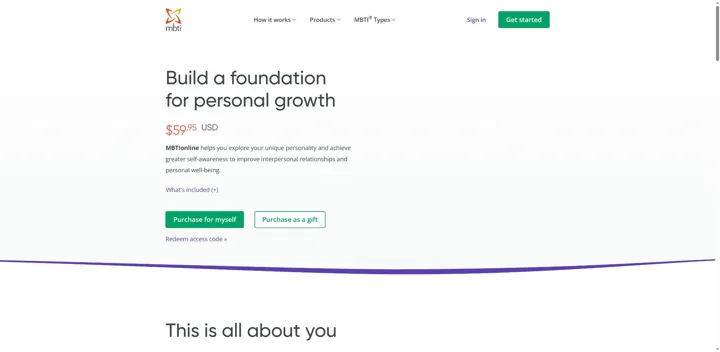
Screenshot of MBTIonline website
The Myers-Briggs Company · Actual site screenshot
What does it cost?$59.95 USD
Explore MBTIonline

If your question is “Which one is the actual Myers-Briggs assessment?”, here it is. MBTIonline comes from The Myers-Briggs Company, rather than borrowing a familiar four-letter format for a different test.

The experience includes a guided process for checking your best-fit type. That matters: the point is to think about which description fits your experience, rather than let four letters introduce themselves and take over. There are also development materials and comparison tools to keep the conversation going after the assessment.

This is the more deliberate, paid outing on the list. The personal-growth product is listed at $59.95 USD, and the provider suggests about 45 minutes for the assessment and verification together. It makes sense if you want this particular instrument and its interpretation process. If you only want a quick peek at personality types, the free alternatives may be enough to satisfy your curiosity.

Try this: Ask yourself what you want from the official version before paying. A recognizable name and your own goal are two different things.

Pros

  • The official MBTI product from its publisher
  • Guided interpretation helps you consider the result
  • Development content gives you somewhere to go next

Cons

  • The listed personal-growth price is $59.95 USD
  • Set aside about 45 minutes, rather than a spare moment
Sources & the small print

Price details: Official personal-growth product lists $59.95 USD. Checkout, taxes and regional pricing were not checked.

Access: The product describes access through an active account with saved assessment results.

Evidence: The publisher links reliability and validity information. That evidence concerns the MBTI instrument and stated uses, not every free four-letter quiz.

Background: Official online product from the MBTI publisher. Its type framework measures four preference pairs.

What we checked: Official public pages and interface reviewed; full questionnaire, result and checkout flows not all tested. Checked October 29, 2026.
06

Keirsey

For wondering why everyone approaches the same problem differently.

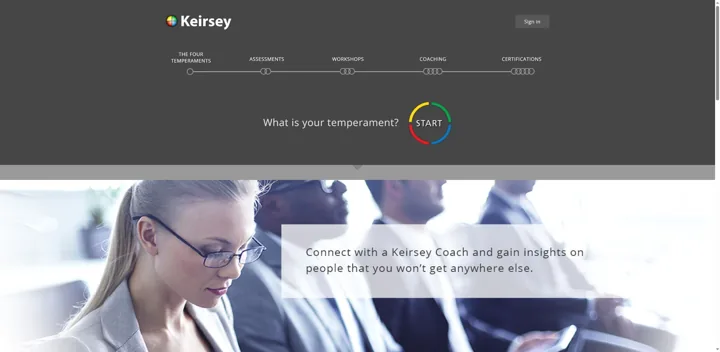
Screenshot of Keirsey website
The Keirsey Group · Actual site screenshot
What does it cost?Paid reports; basic access unverified
Explore Keirsey

Picture four friends planning a trip: one wants an adventure, one wants the arrangements settled, and somebody has already started a discussion about what the journey means. Keirsey’s four temperaments offer one way to think about those different instincts: Artisan, Guardian, Idealist and Rational.

There is plenty to browse beyond the temperament names. The site connects its approach to work, careers, leadership and relationships, with a collection of reports and other services built around those subjects. That makes it an interesting stop if you want to take a personality description into a more practical conversation.

Do check the price of the experience you want before starting. The retail report page lists different products at different prices, from $24.95 for Learning to $99.95 for Leadership; current basic-result access was not confirmed in this review. Browse the temperament descriptions first, then decide whether a particular report answers a question you actually have.

Try this: Pick one real-life situation—teamwork, study or relationships—and see whether the framework helps you describe it more clearly.

Pros

  • Four temperaments are easy to get your head around
  • Descriptions connect with everyday work and relationships
  • Different reports cater to different interests

Cons

  • Detailed reports are paid products
  • Basic-result access still needs checking before you begin
Sources & the small print

Price details: Retail reports listed from $24.95 for Learning to $99.95 for Leadership. Careers $37.95; Workplace $44.95. Currency is displayed with a dollar sign; checkout, tax and availability were not checked. Current basic-result access not verified.

Access: Sign-in and an assessment portal are offered; current requirements not verified.

Evidence: A temperament framework centered on four broad groups. The reviewed pages describe products and applications; independent validation of the current online implementation was not established here.

Background: Keirsey dates its own online assessment to 1996; this is distinct from independently hosted earlier adaptations.

What we checked: Official public pages and interface reviewed; full questionnaire, result and checkout flows not all tested. Checked October 29, 2026.
07

Humanmetrics

For a type quiz that comes with plenty of reading detours.

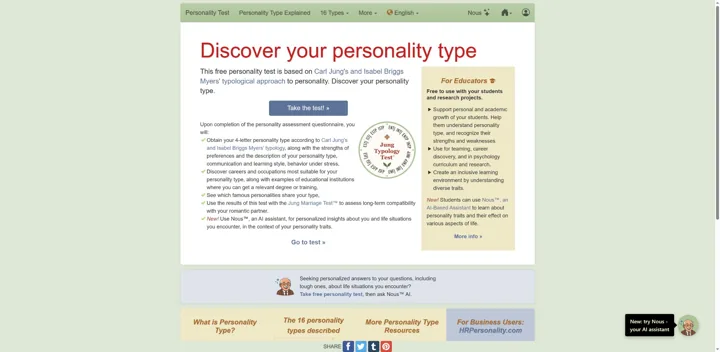
Screenshot of Humanmetrics website
Humanmetrics · Actual site screenshot
What does it cost?Free basic test; paid extras
Explore Humanmetrics

Humanmetrics gets straight to the personality-type question, then offers enough side roads to keep a curious person busy. Its Jung Typology Test returns a four-letter type and the strength of your preferences, with material about communication, learning, careers and reactions to stress.

Those everyday angles give the result somewhere to land. Instead of stopping at “I am this type,” you can start asking why one meeting leaves you buzzing and another leaves you looking for the nearest exit. Famous-person comparisons add a lighter diversion, and separate relationship tools offer another place to explore.

The basic test and descriptions are free, and the provider says its free quizzes do not require registration. Some extra products, including career reports, cost money. This is Humanmetrics’ own instrument, not the official MBTI—useful to know when comparing sites that hand you similar-looking letters.

Try this: Follow the communication or stress-reading links. They may give you a more useful talking point than the type name alone.

Pros

  • Free basic test without registration
  • Useful reading about learning, work and communication
  • Famous-person comparisons add a little extra curiosity

Cons

  • Similar-looking type codes do not make it the official MBTI
  • Some reports and separate tools are paid
Sources & the small print

Price details: Free Jung Typology Test and type descriptions; separate premium products, including career reports. Current premium prices not verified.

Access: The provider states that its free quizzes need no registration; premium purchases require registration.

Evidence: Its own proprietary Jung/Briggs Myers-style instrument, explicitly distinguished from official MBTI. A four-letter result does not make instruments interchangeable.

Background: The reviewed site shows a 1998–2026 copyright range; a copyright range alone does not verify the test launch date.

What we checked: Official public pages and interface reviewed; full questionnaire, result and checkout flows not all tested. Checked October 29, 2026.

08

IDRlabs

For a little Hollywood with your personality scores.

Screenshot of IDRlabs website
IDRlabs · Actual site screenshot
What does it cost?Reviewed test is free
Explore IDRlabs

A chart of personality traits is one thing. Wondering which movie star might have a similar profile is quite another. The IDRlabs test reviewed here puts those two ideas together: a Big Five-style questionnaire followed by a celebrity comparison.

The provider describes 50 questions and a comparison set of 57 movie stars and talk-show hosts. It is an entertaining way into otherwise abstract trait scores. A familiar face gives you something to react to, whether the response is “I can see that” or an immediate request for a recount.

The reviewed test is free. Keep the celebrity resemblance in the playful part of your brain: matching a profile is not the same as knowing the person, sharing their talent or predicting their life. The site also identifies its own proprietary questionnaire, so do not assume it is identical to every other test carrying a Big Five label.

Try this: Look at the traits behind the famous face. That is where the more interesting comparison begins.

Pros

  • The reviewed test is free
  • Celebrity comparisons make the scores less abstract
  • A clear hook for people who find plain charts uninviting

Cons

  • Celebrity similarity is a playful interpretation
  • This is its own instrument, not a universal Big Five test
Sources & the small print

Price details: The official test page states it is free.

Access: Questions are publicly visible; whether a later result step requires an account was not tested.

Evidence: The provider cites Big Five research and statistical controls. The reviewed page does not establish independent validation of this instrument or celebrity matching.

Background: An IDRlabs proprietary CT-NEO-IP-II test. Its page explicitly distinguishes it from IPIP-NEO and NEO PI-R.

What we checked: Official public pages and interface reviewed; full questionnaire, result and checkout flows not all tested. Checked October 29, 2026.

09

The Attachment Project

For the “why do I do that in relationships?” conversation.

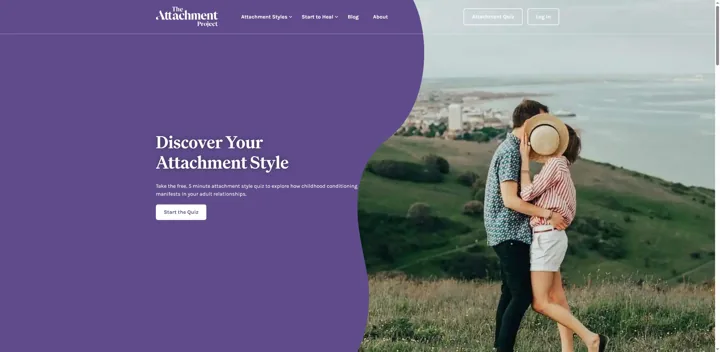
Screenshot of The Attachment Project website
The Attachment Project / MindOnly Pty Ltd · Actual site screenshot
What does it cost?Free quiz; paid learning products
Explore The Attachment Project

One person wants reassurance. Another needs a little space. A third has already reread the last text message six times. The Attachment Project explores patterns of closeness and connection through its attachment-style quiz.

The site introduces secure, anxious, avoidant and disorganized patterns, then gives you articles and learning resources to follow up. Its narrower focus is the attraction: rather than trying to describe your whole personality, it gives you a way to reflect on what happens when relationships feel comfortable, uncertain or demanding.

The provider calls the quiz free and estimates about five minutes. Workbooks and courses are separate paid products; its terms also describe email delivery of quiz results, so check the current access requirements. Approach the result as a starting point for noticing patterns, rather than a permanent label to apply to yourself—or your ex.

Try this: Use the result to start a kind conversation. It works less well as ammunition in an argument.

Pros

  • A focused way to explore relationship habits
  • Short provider-estimated completion time
  • Articles and learning resources offer follow-up

Cons

  • Check the current email/result requirements
  • A quiz cannot explain an entire relationship or diagnose you
Sources & the small print

Price details: Provider calls the quiz free; related workbooks and courses are sold separately. Paid-product prices not verified.

Access: Terms describe emailing quiz results. Whether email or a registered account is mandatory in the current flow is unknown.

Evidence: Attachment theory and specific attachment questionnaires have separate evidence bases. This review did not establish validation of the current provider implementation.

Background: An attachment-focused provider quiz; exact launch date and current underlying questionnaire version not verified.

What we checked: Official public pages and interface reviewed; full questionnaire, result and checkout flows not all tested. Checked October 29, 2026.

10

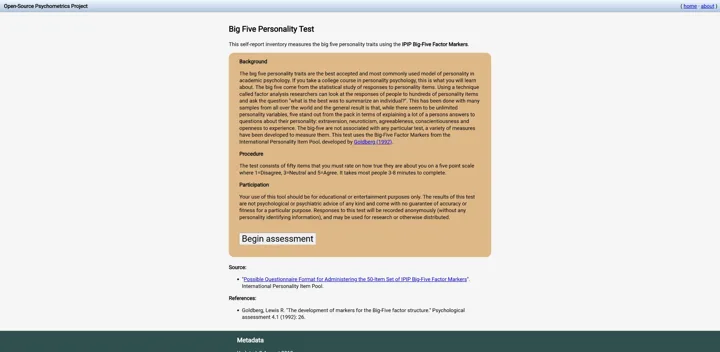
OpenPsychometrics

For the curious person who always clicks “how does this work?”

Screenshot of OpenPsychometrics website
Open-Source Psychometrics Project · Actual site screenshot
What does it cost?Public entry; full access not verified
Explore OpenPsychometrics

OpenPsychometrics feels like finding a room full of personality experiments with the notes still on the desk. There is a 50-item Big Five test if you want trait scores, and a fictional-character quiz if your burning question is closer to “Who would I be in a story?”

The character quiz has a particular twist. You place yourself between pairs of adjectives, and the system compares those ratings with character profiles built from volunteer descriptions. There are also peer-report and couples versions. That gives you several ways to explore the gap between how you see yourself and how someone else might describe you.

The presentation is plain, but the development notes are part of the appeal. You can read where the ideas and questions come from instead of treating the result as a mysterious pronouncement. Check the participation notes before submitting: the Big Five entry discusses anonymous response collection, and the character quiz asks about including responses in its research database.

Try this: Try the character quiz with someone who knows you well. Compare your impressions, not just your matches.

Pros

  • Methods and source material are easy to investigate
  • Trait tests and character matches offer different routes in
  • Peer-report and couples variants add another angle

Cons

  • The interface is plainer than the polished quiz sites
  • Read the research-data participation notes before answering
Sources & the small print

Price details: Public assessment entry has no stated fee or purchase prompt. A full-flow pricing guarantee was not verified.

Access: The entry describes anonymous participation with no account prompt; later requirements were not tested.

Evidence: The official IPIP source publishes scale keys. Research on the item family and framework does not guarantee any individual web result.

Background: Uses public-domain IPIP Big-Five Factor Markers and cites Goldberg's 1992 marker research.

What we checked: Official public pages and interface reviewed; full questionnaire, result and checkout flows not all tested. Checked October 29, 2026.

A good quiz starts
with a little honesty.

Including from us. Here’s what we looked at, what “free” means, and who’s behind this guide.

What did we actually check?

Official pages, visible interfaces, available documentation and pricing information. The screenshots are real. Full questionnaires, results and purchase flows have not all been tested; the source notes say where details still need checking.

Can I see my results for free?

Sometimes the whole result is free. Sometimes there is a free summary and a paid report. Sometimes the assessment costs money upfront. We spell out the differences and leave unknown prices marked as unknown.

How seriously should I take it?

A trait inventory, a type description and a celebrity match offer different things. Research into a framework does not automatically validate every website using it. Enjoy the discoveries, question what doesn’t fit, and keep a little room for being complicated.

A word about ownership

This guide shares ownership with AnimalInYou.com, which is also disclosed beside its review. Every website gets the same kind of write-up, with pros, cons and sources. This is an editorial selection, not a clinical recommendation or a measured accuracy ranking.

Before the “share my result” button…

There was the magazine quiz.

Long before group chats could debate your personality type, magazine readers were adding up answers and turning to the results. Cosmopolitan helped make that kind of self-discovery quiz a familiar pleasure. It didn’t invent personality testing, but it certainly helped make “what does this say about me?” a tempting question. A little magazine history ↗

The web gave the format a new home. An early Keirsey test developer records putting a version online in 1994. Today you can explore detailed trait profiles, compare characters, puzzle over relationships or discover your inner animal—without finding a pencil first. An early web-test story ↗